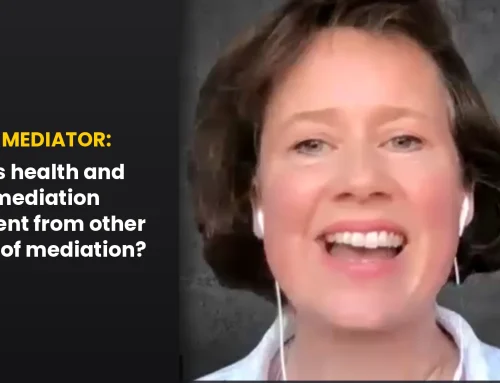
What is mediation, and how does it work?
Mediation is a structured process that helps people who are in disagreement to communicate, explore options and make decisions about how they want to move forward.
In this short Ask a Mediator video, Arabella Tresilian explains the fundamentals of mediation, including the four principles that underpin the process: confidentiality, impartiality, voluntariness and self-determination.
What is mediation?
A useful way of describing mediation is facilitated negotiation.
Negotiating directly with someone when there is disagreement can be difficult. Emotions may be high, communication may have broken down, or the parties may have very different understandings of what has happened and what needs to happen next.
A mediator provides a structured space in which everyone can be heard.
The mediator helps to establish a constructive process, understand the issues, manage the pace of the discussion and support the parties to hear and respond to each other. The mediator then helps the parties move towards decision-making.
Importantly, the mediator does not make the decisions for the parties.
What are the four principles of mediation?
There are four key principles which underpin mediation:
- Confidentiality
- Impartiality
- Voluntariness
- Self-determination
These principles help distinguish mediation from processes in which an external person or body makes a determination about a dispute.
1. What does confidentiality mean in mediation?
Confidentiality is a fundamental feature of mediation.
What is said to the mediator is generally confidential. Information shared in the mediation is not normally passed on to others without the appropriate agreement.
There can be specific and exceptional circumstances in which confidentiality has limits. These should be explained and discussed with the parties as appropriate.
The discussions in the mediation are confidential, and the agreement reached is also confidential unless the parties agree that some or all of it can be shared.
For parties who need a safe environment in which to have difficult conversations, this confidentiality can be particularly valuable.
2. What does impartiality mean in mediation?
A mediator is impartial.
The mediator is not there to take sides, decide who is right or wrong, allocate blame or advocate for one party.
The mediator’s role is to support a fair and constructive process in which everyone involved has the opportunity to be heard and to participate in finding a way forward.
This is different from legal representation. A solicitor or barrister advises and represents their client. A mediator does not advocate for either party.
The mediator also does not determine the outcome.
3. Is mediation voluntary?
Mediation is traditionally a voluntary process.
This means that parties choose whether to participate and can generally decide whether they wish to continue.
There have been changes to the legal landscape in relation to mediation, and there are circumstances in which parties may be encouraged or required to attempt mediation or another form of dispute resolution.
The principle of voluntariness remains important, however. In the workplace and health and social care mediation undertaken by Health and Care Mediation, participation in the mediation process is voluntary.
If someone feels that mediation is not helping, they can step away from the process. It is usually sensible to discuss this with the mediator before doing so, but there is no expectation that someone should continue with a process that they do not wish to pursue.
4. What is self-determination in mediation?
Self-determination means that the parties themselves decide the outcome.
This is one of the important differences between mediation and adjudicative processes such as litigation or a formal determination.
In court proceedings, a judge makes a decision. In an employment tribunal, a tribunal determines the issues before it. In other formal processes, an external decision-maker may decide whether a complaint is upheld or what should happen.
In mediation, the parties make their own decisions.
The mediator can help them explore possibilities, test options and consider what might work, but the decisions belong to the parties.
This gives people agency over what happens next.
It is also perfectly possible for mediation to end without an agreement. The process can still provide an opportunity for people to clarify their views, understand the other person’s position and consider their options for the future.
Is mediation focused on the past or the future?
Mediation is generally future-focused and solution-focused.
The purpose of mediation is not usually to establish a definitive account of what happened in the past or to determine who was right or wrong.
Instead, the mediator helps the parties consider what needs to happen next.
The outcome might include:
- an agreement about how people will work together
- a protocol for future communication
- actions with agreed timescales
- decisions about treatment or care
- arrangements for future contact
- practical steps to repair a working or personal relationship
- an agreement to bring a dispute to an end
The precise outcome will depend on the circumstances of the dispute and what the parties are able and willing to agree.
Does mediation deal with what happened in the past?
Yes. Being future-focused does not mean that the past is ignored.
Sometimes it is necessary to talk about what has happened in order to understand the present situation.
Parties may need to describe their experience, explain why trust has broken down, acknowledge the impact of previous events or understand why communication has become difficult.
In some disputes, this process of understanding is essential before people can consider what they are prepared to agree for the future.
Mediation may therefore provide an opportunity for resolution, restoration, rebuilding trust and repairing relationships.
However, the mediator will not normally make a finding about the past or give an opinion about which party was right.
The parties may choose to record something about what happened in their agreement, but they may also choose not to do so.
The emphasis remains on establishing a workable way forward.
Can mediation take place alongside legal proceedings?
Yes. Mediation does not necessarily have to be an alternative to formal legal proceedings.
It can take place before proceedings are issued, during proceedings, or alongside existing court or tribunal processes.
In health and care disputes, for example, mediation may be appropriate where there is disagreement about treatment or care, Court of Protection matters, end-of-life decisions, judicial review or other complex issues. It can also be used in workplace disputes involving professional, interpersonal or organisational conflict.
Where legal proceedings are already underway, legal representatives remain central to advising their clients about their legal rights, duties and risks. The mediator’s role is different: to facilitate constructive dialogue and support the parties to explore whether an agreed resolution is possible.
Why might mediation be valuable in a complex dispute?
Mediation can be particularly useful where a dispute involves more than a straightforward disagreement about the law or the facts.
Health and care disputes, for example, can involve clinical judgement, statutory duties, ethical questions, family relationships and deeply personal consequences. Workplace disputes can involve professional relationships and organisational responsibilities alongside the immediate disagreement.
A court or tribunal may be able to determine the legal issues in a dispute. Mediation can provide an opportunity to explore questions that fall outside the scope of a formal determination:
What do the parties need in order to move forward?
What would a workable resolution look like?
What needs to change in the relationship or communication between the parties?
What can the parties agree that an external decision-maker could not impose?
These conversations can sometimes produce practical outcomes that would not be available through a purely adjudicative process.
What happens if mediation does not result in an agreement?
Mediation does not guarantee an agreement.
If the parties cannot reach a resolution, they retain their other options, including formal processes where appropriate.
The confidential nature of mediation means that discussions within the mediation cannot simply be carried into those formal processes as evidence of what a party has said or proposed, subject to the applicable legal and procedural framework.
Even where no final agreement is reached, mediation may help clarify the issues, narrow the areas of disagreement or identify options that the parties had not previously considered.
Health and Care Mediation
Health and Care Mediation provides mediation services for disputes in healthcare, social care and the workplace.
The practice works with solicitors, NHS Trusts, local authorities, care providers and others involved in complex disputes.
Mediation can be used in relation to treatment and care planning, Court of Protection matters, end-of-life and palliative care, and a range of workplace and interpersonal disputes.
The process can be adapted to the circumstances of the case and the needs of the people involved. Mediation may take place before, during or after formal proceedings, or independently of them.
About Arabella Tresilian
Arabella Tresilian is the founder of Health and Care Mediation and a mediator specialising in complex health and social care, workplace and interpersonal disputes.
She is registered with the Civil Mediation Council and the International Mediation Institute.
Through Health and Care Mediation, Arabella provides mediation services for healthcare, social care and workplace disputes, supporting people to navigate difficult conversations, resolve conflict and identify workable ways forward.
Considering mediation?
If you are a solicitor, barrister, organisation, professional or individual considering mediation for a health, social care or workplace dispute, Health and Care Mediation can provide an initial discussion about whether mediation may be appropriate and what the process could look like.
Find out more about Health and Care Mediation at healthandcaremediation.com.
You can also watch the accompanying Ask a Mediator video here:
What Is Mediation? The 4 Principles That Make Mediation Work
The purpose of mediation is not necessarily to determine who is right. It is to provide a structured process in which the people involved can explore what needs to happen next and decide whether they can reach an agreement themselves.